Vodnik po kablih CPRI: Huawei, Primerjava Nokia in Ericsson
septembra 15, 2026
Choosing akabel CPRIfor a telecom site means matching more than a brand name. Huawei, Nokia and Ericsson installations can use different connector protection systems, cable constructions and optical configurations. A cable that looks similar may still have the wrong housing, fiber type or termination for your equipment.
This guide explains how CPRI fiber cables work, compares three representative cable styles in Sogoo’s range, and shows what to confirm before ordering.
What Is a CPRI Cable?
CPRIstands forCommon Public Radio Interface. It defines a connection between Radio Equipment Control (REC) and Radio Equipment (RE). In a distributed base station, this is commonly described as the link between a baseband unit (BBU) and a remote radio unit or remote radio head (RRU/RRH).
The cable carries the optical signal between transceivers. The connected equipment implements the protocol. An optical cable does not generate CPRI traffic, change its line rate or make two incompatible radios work together.
The CPRI specificationsupports optical and electrical interfaces. This article focuses on outdoor fiber assemblies used in fiber-to-the-antenna (FTTA) installations. CPRI permits both single-mode and multimode fiber implementations; the installed optics and link requirements determine which is suitable.
Huawei vs Nokia vs Ericsson: CPRI Cable Comparison
The table below comparesrepresentative Sogoo cable assemblies for these brands. It is not a universal interface rule for every radio generation or model.
Equipment application
Example cable style
Main physical distinction
What to verify
Huawei
DLC–DLC outdoor cable with armored branches
Duplex LC ends with protective branch tubing
Fan-out length, port access, gland fit and fiber specification
Nokia / legacy NSN
LC OD–LC OD cable with NSN-style boots
Protective boot and mating arrangement around the LC connection
Exact boot/interface version, cable code, fiber mode and length
Ericsson
FullAXS-to-LC outdoor fiber assembly
FullAXS housing protects the radio-side optical connection
Housing size/version, opposite-end connector, fiber count and full part number
Huawei CPRI Cable: DLC Connectors and Armored Branches
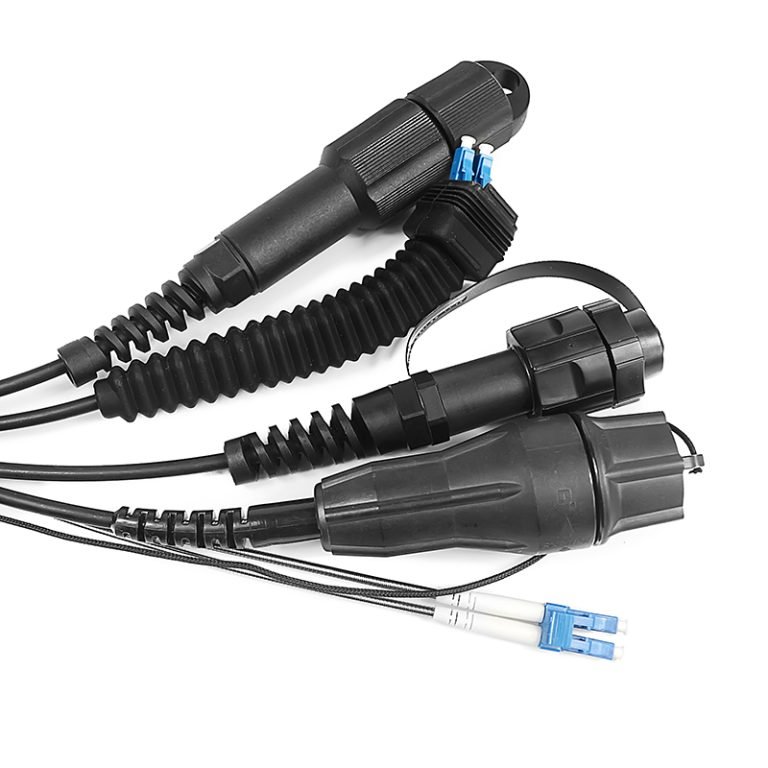
One example in Sogoo’s Huawei-compatible range is theDLC–DLC CPRI cable with armored branches. DLC denotes a duplex LC arrangement. Protective tubing surrounds the breakout sections leading to the connectors.
When replacing this style, compare the complete assembly drawing. Check the length of each branch, the available space around the optical port and how the cable passes through the equipment’s sealing arrangement. Bare LC connectors alone do not establish an outdoor ingress-protection rating.
Sogoo’s listing includes both single-mode and multimode options. Specify the exact fiber required by the installed transceivers instead of treating “Huawei CPRI cable” as a complete specification.
Example: DLC cable with protected branches for Huawei applications.
Nokia CPRI Cable: NSN Boots and LC OD Assemblies
Nokia-compatible assemblies in Sogoo’s range includeFUFAS LC OD–LC OD cable with NSN-style boots. The product title identifies a 2 m multimode example compatible with Nokia reference 472509A.102.
The boot and mating arrangement are key identification details. Compare both connector ends, including the shape and length of the protective boot. A standard LC connector with a different outer cover should not be assumed to fit the same radio port.
Other lengths and optical configurations must be specified separately. The fact that one Nokia cable is multimode does not make all Nokia radio links multimode.
Example: Nokia-compatible fiber assembly with NSN-style protective boots.
Ericsson CPRI Cable: FullAXS-Protected Optical Connections
A representative Ericsson-compatible option is Sogoo’sRPM2531610/100M FullAXS fiber patch cable. This product family uses an LC optical interface with a protective FullAXS housing.
FullAXS describes the connector protection system, not a separate CPRI protocol. TE Connectivity’s FullAXS documentationshows LC configurations, bayonet locking and different housing sizes. Match the specified version and mating hardware rather than selecting by appearance alone.
Check the complete Ericsson cable reference, including the length suffix, and confirm whether the opposite end is plain LC or another protected interface. Do not assume that every Ericsson assembly has the same fiber count or uses FullAXS.
Example: FullAXS-to-LC cable for Ericsson applications.
Can You Interchange CPRI Cables Between Brands?
Sometimes an assembly can serve more than one application, but compatibility must be established at three levels:
Mehanski:connector geometry, housing, locking mechanism, cable gland and fan-out must fit.
Optical:fiber mode, connector polish, fiber count, polarity, wavelength and link loss must match the optical design.
Oprema:radio, baseband and transceiver support must be confirmed. A shared connector or CPRI label is not proof of cross-vendor interoperability.
Na primer, removing a protective cover may expose a familiar LC interface, but it can also remove the specified sealing and strain relief. Confirm a replacement against the equipment documentation and the approved cable drawing.
Single-Mode, Multimode and Cable Length
Select fiber from the transceiver specification. Record the optical module part number, operating wavelength, required fiber category and supported distance. Then check the complete optical path, including patch panels, connectors and splices.
A longer cable does not automatically require a different connector housing. Likewise, a cable sold as “10G” or “5G” does not by itself guarantee a working link. The optics, equipment configuration and installed channel determine performance.
CPRI vs eCPRI: Does the Cable Change?
CPRI and eCPRI are different interface specifications. eCPRI supports packet-based fronthaul transport; changing a passive fiber jumper does not convert a CPRI radio into an eCPRI radio. Some fiber infrastructure can be reused where the new optics and physical interfaces are compatible. Confirm the radio, transport equipment and transceiver requirements before reuse.
CPRI Cable Ordering Checklist
Equipment brand, exact BBU and RRU/RRH models, and port photographs.
Complete cable part number or an approved assembly drawing.
Connector and protective housing required at end A and end B.
Single-mode or multimode fiber category, fiber count and polarity.
Total cable length, branch lengths, outer diameter and jacket requirements.
Outdoor sealing, bend-radius, pulling and armor requirements for the installation.
Količina, destination and required delivery date.
Optical test report requirements, including insertion loss and continuity.
Frequently Asked Questions
Is CPRI cable the same as a power cable?
št. A CPRI fiber cable carries optical communications signals. DC power is supplied separately unless a specified hybrid assembly combines separate fiber and power elements.
Are all CPRI cables duplex LC?
št. Duplex LC is common in the examples shown here, but CPRI does not require every implementation to use one connector format. Follow the equipment’s specified interface.
Does an IP67 housing make any cable assembly waterproof?
št. Protection depends on the specified mating components, seals, cable diameter and correct installation. Confirm the rating and conditions for the complete assembly.
Can I order using only “Huawei,” “Nokia” or “Ericsson”?
The brand is a starting point. Include the equipment model, both connector ends, fiber specification and cable length so the supplier can identify the correct assembly.


 DB9 proti DB15 proti krožnemu ISG RET kablu: Polna aplikacija & Vodnik po znamki
 BREZPLAČNI RET kabli: 4-Zatič, 5-Zatič & 8-Pin – kakšne so razlike?
 Vodnik po kablih CPRI: Huawei, Primerjava Nokia in Ericsson
 Najboljše blagovne znamke telekomunikacijskih priključkov: amfenol, Jonhon & Pregled napajalnih priključkov Huawei RRU
 Kabel AISG: The Ultimate Solution for Huawei RRU RET Port Connectivity
